Our Approach
Why we do things differently
Ninety years of gorse control in New Zealand has taught us one clear lesson: no single method beats gorse on its own. A spray without follow-up planting fails. Fire without revegetation fails. Mechanical clearing without herbicide fails. Biological control without active management fails. Every one of these approaches falls down at the same point — the seed bank. Kill the visible plant and you've done nothing to the thousands of dormant seeds waiting beneath it, ready to flush the moment the ground is disturbed or the canopy opens.
The Wellington Region Hills Environmental Trust exists because Wellington's steep, cross-boundary hill terrain has defeated the conventional toolkit for decades. Our approach is built around two things the old toolkit lacked: a way to safely and precisely treat terrain that ground-based methods and helicopters can't reach, and a fully sequenced, long-term programme that never lets the seed bank get the last word.
The Trust's model, step by step
1. Site assessment and mapping
Every programme starts with a clear picture of the problem. We map the extent of infestation, identify terrain constraints, note proximity to waterways and native bush, and record the native species already present on site. This groundwork determines which combination of tools a site needs — and it's the step that gets skipped too often elsewhere.
2. Drone-assisted herbicide treatment
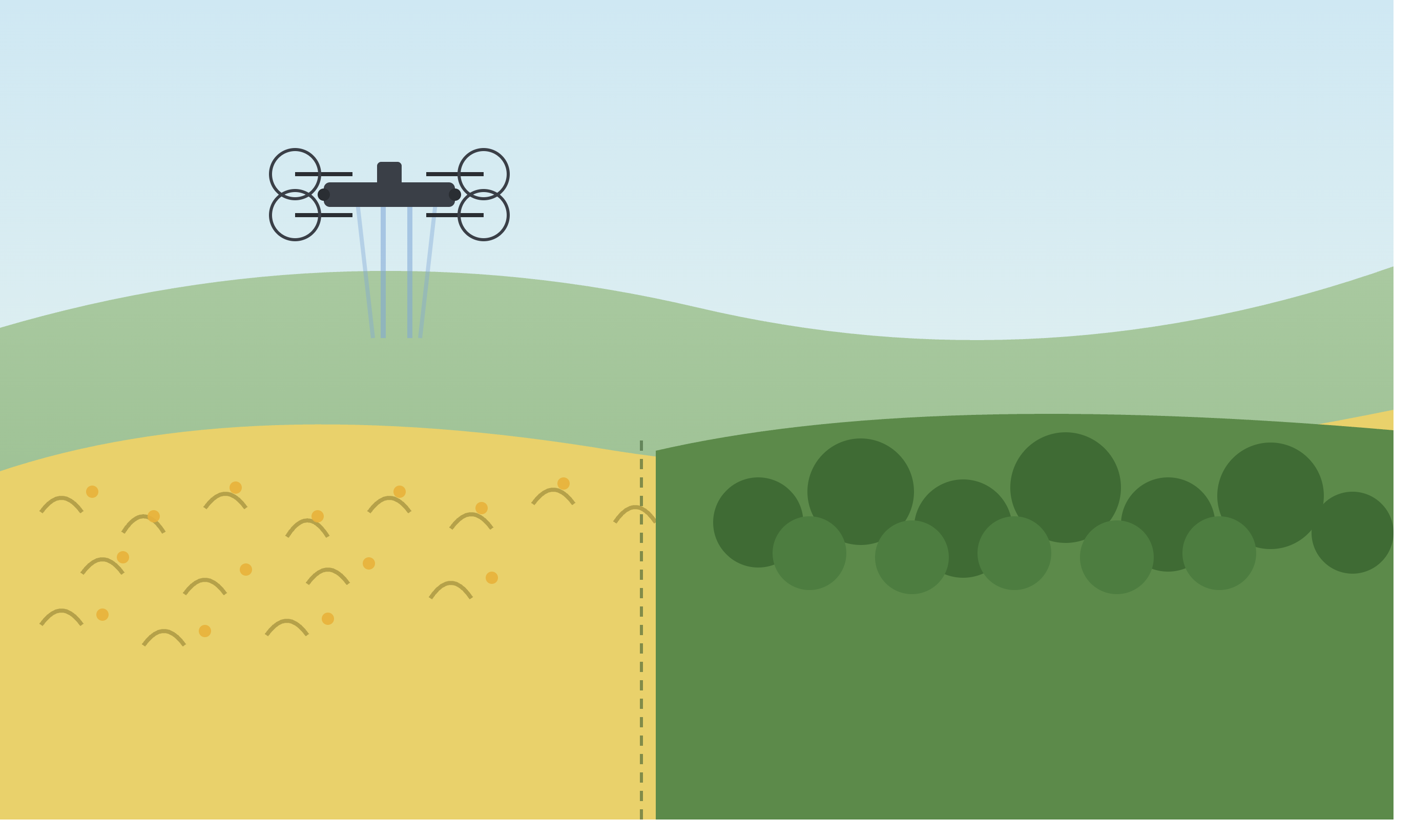
This is the innovation at the centre of our model. Agricultural spray drones — platforms like the DJI Agras T50, flying with centimetre-level RTK GPS accuracy — can reach the steep slopes, gullies, and cliff faces that have always been the hardest part of Wellington's gorse problem. Where ground crews can't safely stand and helicopters can't spray precisely enough, drones can treat the target plants directly, with minimal drift, at a fraction of the herbicide volume and cost of conventional aerial spraying. No one has to enter unstable, prickly, steep terrain to do it.
Where terrain allows safe ground access, we use conventional herbicide application instead — drones are our answer to the terrain that has always been untreatable, not a replacement for every method.
3. Mechanical follow-up, where it helps
On accessible ground, we mulch or clear dead material to reduce fire fuel load and open the site for planting. On steep terrain where machinery can't safely operate, we leave dead material to collapse in place, where it provides some temporary suppression of seedling germination. We're careful with this step — soil disturbance from clearing can trigger a worse seedling flush than the original infestation, so it's never done without a planting plan already in place.
4. Immediate native planting
This is the step we treat as non-negotiable, because it's the one most programmes underinvest in. Native species go in as soon as possible after treatment, chosen for local provenance and for their ability to compete with gorse seedlings on wind- and drought-exposed sites. Every week of bare ground after treatment is a week the seed bank has to get ahead of us.
5. Seedling management
We monitor treated sites through their first one to two years and treat emerging seedlings before they establish. This is the phase where funding shortfalls cause the most programmes to fail — a site that looks "done" after the first treatment isn't done until the seedling flush has been dealt with too.
6. Supporting native canopy closure
As planted natives grow tall enough to shade out remaining gorse — typically three to five years on sheltered sites, longer on exposed ridgelines — gorse regeneration declines on its own. Our goal at every site is to get native cover to this point before the seed bank can re-invade.
7. Long-term monitoring
We establish monitoring plots and track native establishment and any gorse regrowth well beyond the standard five-year check-in — ten-plus years is our benchmark for calling a site secure.
Solving the boundary problem
Wellington's gorse doesn't respect property lines, and neither does its regrowth. Much of the region's worst-affected hill country spans multiple landowners, reserve land, and council boundaries, which means an individual landowner's efforts can be undone by re-invasion from next door. A core part of our role is the coordination this requires: bringing landowners, Greater Wellington Regional Council, and Wellington City Council together, securing access and consent across boundaries, and sequencing treatment so that neighbouring sites are dealt with together rather than in isolation.
We also see targeted grazing — goats, in particular — as a valuable low-chemical option where fencing and land tenure allow, and we work with willing landowners to make that possible on accessible margins and reserve land.
What we're not claiming
We don't treat any of this as a quick fix. The evidence from sites like Hinewai Reserve shows native forest can eventually reclaim gorse-covered land — but that took 15 to 20 years under near-ideal conditions: a nearby native seed source, freedom from browsing animals, and decades most urban-fringe communities can't wait out. In Wellington's fire-prone, urban-interface terrain, we don't have the luxury of passive succession on priority sites. Our approach is active, sequenced, and long-term because that's what the evidence says actually works — not because it's the easiest thing to promise.
The outcome we're working toward
Every hectare of gorse permanently replaced by native forest is a lasting gain — for biodiversity, water quality, fire safety, and the communities living in and around Wellington's hills. Solving Wellington's gorse problem will take years of consistent investment and genuine partnership. Our approach is designed to make that investment count.