1. Gorse in Wellington
What is Gorse
A golden menace hiding in plain sight — and why its roots in Wellington go deeper than you might think.
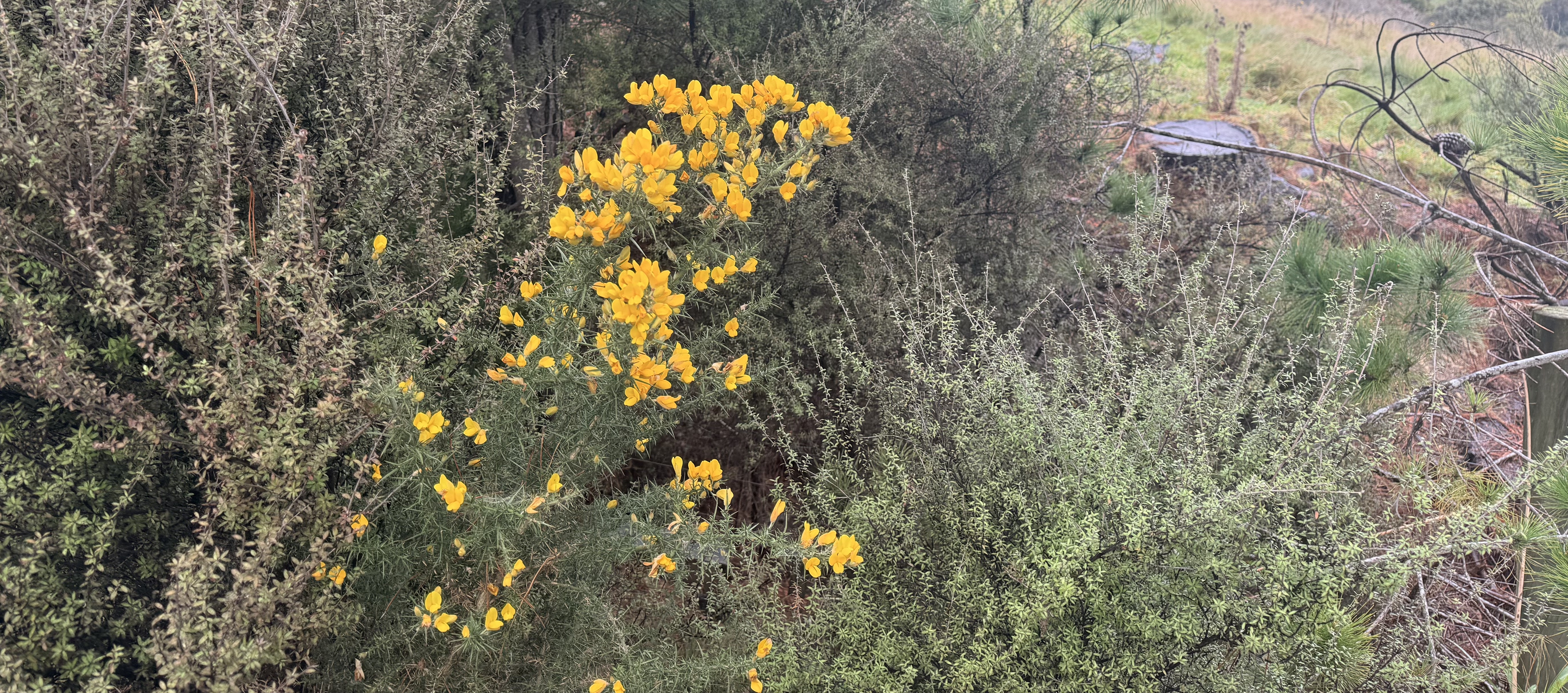
If you have spent time walking Wellington\'s hills, you will know gorse. Its dense, thorny thickets line tracks, colonise steep gullies, and erupt in waves of bright yellow flowers that can, in a certain light, look almost beautiful. But behind that cheerful colour lies one of New Zealand\'s most persistent and costly environmental problems — a plant that was deliberately brought here, warmly welcomed, and then revealed itself to be almost impossible to get rid of.
Understanding what gorse is, how it behaves, and why it thrives in New Zealand is the first step to understanding why the Wellington Region Hills Environmental Trust exists — and why solving this problem requires new thinking.
Where gorse comes from
Gorse (Ulex europaeus) is a thorny, evergreen shrub native to the coastal heaths and hillsides of western Europe — particularly the British Isles, France, and the Iberian Peninsula. In its home environment it is kept largely in check by a combination of cold winters, poor soils, and a suite of insects and diseases that have co-evolved with it over millennia.
It arrived in New Zealand during the earliest years of European settlement. Seed was brought deliberately from England in the early 1800s, planted as hedging to enclose fields and shelter livestock — a practical solution that made perfect sense to settlers building a familiar agricultural landscape in an unfamiliar country. By 1835, when Charles Darwin passed through the Bay of Islands, gorse was already growing in established hedgerows.
The problem was not apparent at first. As living fences, gorse hedges worked well — they were impenetrable to stock, grew quickly, and required little maintenance. Seed continued to be imported and new plantings deliberately established well into the 1900s. It was, as one nineteenth-century New Zealand newspaper put it, a good servant.
By the time the threat was recognised, gorse had already escaped its fences and was spreading across the landscape. It. was declared a noxious weed by Act of Parliament in 1900, yet live gorse fences continued to be planted for another fifty years, creating a paradox that still shapes our relationship with this plant today.
Why gorse is so difficult to manage
Gorse is not simply a fast-growing weed. It is a remarkably well-adapted plant with several biological traits that make it exceptionally difficult to control — particularly in New Zealand\'s climate, which suits it even better than its European homeland.
It grows larger and more vigorously here than in Europe
In its native range, gorse is regulated by cold winters and by insects and fungi that damage its growth and reduce its seed production. None of these natural enemies exist in New Zealand. The result is a plant that grows bigger, flowers for longer, and produces more seed here than it ever would at home. Research has confirmed that gorse grows more vigorously in New Zealand than in its native range — the very conditions that made it useful as a hedge also made it dangerous as an escape.
Its seeds can survive in the soil for decades
This is perhaps gorse\'s most alarming characteristic. The seeds have a hard, water-impermeable coat that allows them to lie dormant in the soil for up to 30 years — with some reports of viable seeds after 70 years. A single gorse plant can produce 500 to 600 seeds per square metre each year. Those seeds accumulate in the soil, building up what ecologists call a \'seed bank\' — an invisible reservoir of future plants waiting for the right moment to germinate.
This is why cutting or burning gorse rarely solves the problem. Removing the visible plant simply triggers germination from the seed bank below. What looks like a cleared hillside can be covered again within a season.
Fire makes it worse, not better
Gorse is highly flammable — its dry summer foliage burns intensely — and this creates a particular danger in Wellington where gorse stands adjoin residential areas. But fire as a control method carries a cruel irony: heat is one of the triggers that cracks gorse\'s hard seed coat and stimulates mass germination. A burn-off can temporarily clear an infestation but often results in a dense flush of seedlings that is harder to manage than the original stand.
It spreads through multiple means
Gorse reproduces primarily by seed, but its seed pods add another mechanism: when ripe, the pods split explosively on warm days, projecting seeds up to several metres from the parent plant. Seeds are also spread by water, soil movement, and inadvertently by vehicles, machinery, and animals. On steep hill terrain — exactly the kind of landscape that surrounds Wellington — soil disturbance from erosion or earthworks can carry seed downslope into new areas.
New Zealand\'s climate is near-perfect for it
Gorse thrives in mild, wet climates with well-drained soils — a description that fits much of the Wellington region. It tolerates a remarkable range of conditions: wind, salt, low-fertility soils, drought, and frost. This adaptability is why it is found from coastal cliffs to hill tops, and why controlling it in one location offers no protection against re-invasion from surrounding land.
A plant with a complicated reputation
Gorse is not entirely without ecological value — and being honest about this complexity is part of understanding it properly.
As a member of the pea family, gorse fixes atmospheric nitrogen into the soil. This can improve soil fertility on degraded or low-nutrient land. Its dense, thorny structure provides shelter and nesting habitat for some bird species, and its flowers are an early-season nectar source for bees. In some circumstances, gorse has even been observed acting as a \'nursery plant\' — sheltering native seedlings from wind and frost beneath its canopy, then giving way as native trees grow tall enough to shade it out.
Some ecologists and land managers have argued that in certain contexts — particularly on steep, degraded hillsides with no realistic farming future — gorse scrub that is trending toward native regeneration may be worth leaving alone rather than actively managed.
The Wellington Region Hills Environmental Trust takes a practical, evidence-based approach to this complexity. Our focus is on situations where gorse is actively preventing environmental restoration — blocking native regeneration, creating fire risk near homes, or occupying land that has genuine ecological value.
Gorse and the law in New Zealand
In New Zealand, gorse is a declared pest plant under the Biosecurity Act 1993. Regional pest management plans, administered by regional councils, set out the specific obligations that apply to landowners in each area.
In the Greater Wellington region, gorse is classified under the regional pest management plan, which means landowners may have legal obligations to manage it on their land. Many landowners are unaware of this, and the challenge of gorse on steep, inaccessible terrain often means that even willing landowners struggle to meet their obligations with conventional methods.
This is one of the gaps the Trust is working to address — developing practical, accessible tools and approaches that help landowners on difficult terrain manage gorse effectively and meet their legal obligations.
Explore more
This page is part of our Gorse in Wellington series. Continue reading:
- Gorse on Wellington\'s hills — the scale of the problem locally, with maps and data
- Why gorse matters — the environmental, economic, and fire risk implications
- Can gorse be beat? — what conventional approaches can and can\'t do, and where innovation comes in
Sources and further reading
- Magesan, G.N., Wang, H. & Clinton, P.W. (2012). Nitrogen cycling in gorse-dominated ecosystems in New Zealand. New Zealand Journal of Ecology, 36(1): 21–28.
- Massey University New Zealand Weeds Database — Gorse (Ulex europaeus). massey.ac.nz
- Manaaki Whenua Landcare Research — Gorse biological control programme. landcareresearch.co.nz
- Guthrie-Smith, H. (2006 [1921]). Tutira: The Story of a New Zealand Sheep Station. Reed Publishing. (Historical context on gorse spread.)
- Lingenfelder, M. & Dawson, W. (2019). A World of Gorse: Persistence of Ulex europaeus in Managed Landscapes. Plants, 8(11): 523.
- Greater Wellington Regional Council — Regional Pest Management Plan. gw.govt.nz