Why it matters
It is not just a weed. It is an environmental, economic, and safety crisis — and Wellington is living it.
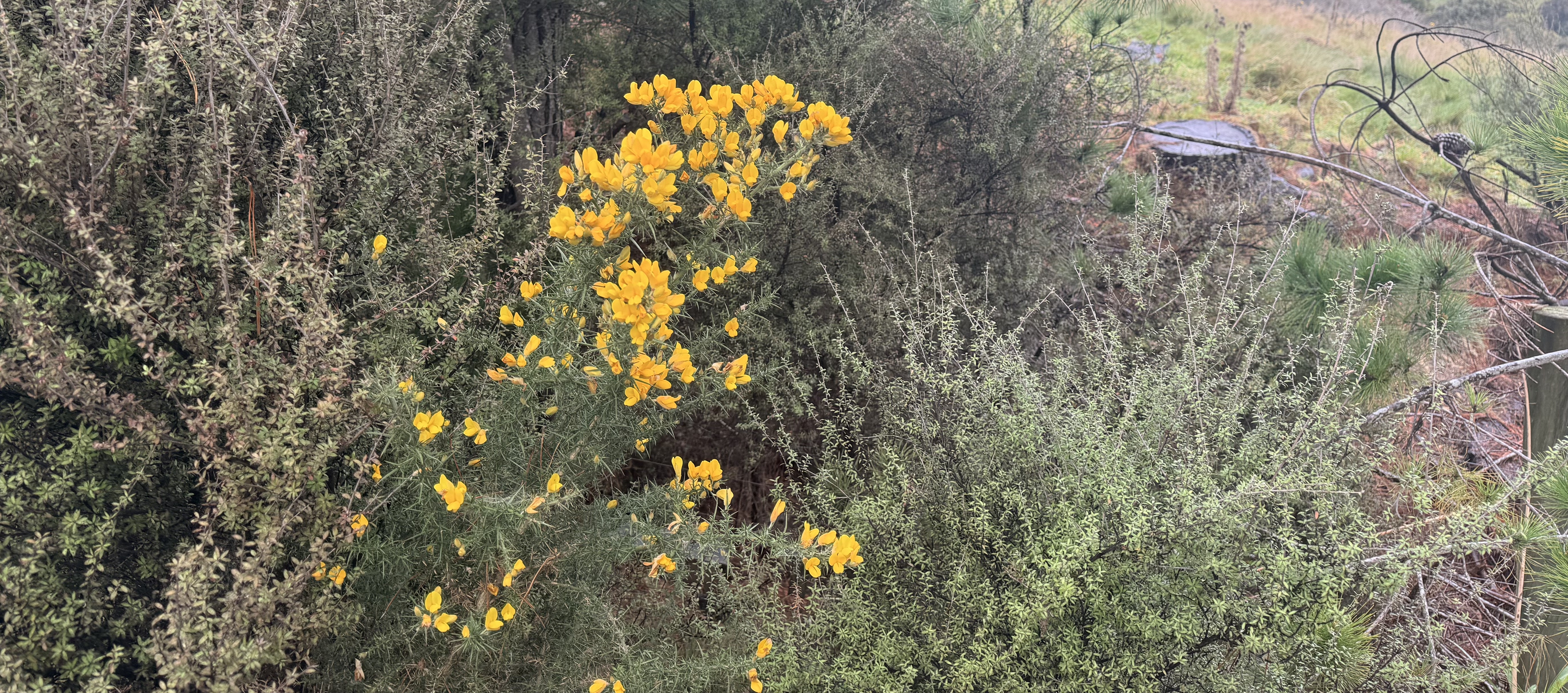
Ask most Wellingtonians about gorse and they will probably describe it as a nuisance — something prickly on the hillside, a bit of an eyesore. Some may even find the spring flowers charming. What fewer people appreciate is that gorse is doing serious, measurable damage: to native wildlife, to the health of waterways, to property values and land productivity, to the safety of the people who live and walk in Wellington's hills, and to the long-term ecological future of the region.
This page sets out the case, plainly and with evidence, for why gorse matters — and why letting it spread unchecked has consequences that extend far beyond the hillside it happens to be growing on today.
The biodiversity cost
New Zealand is one of the most ecologically unique places on Earth. Separated from other landmasses for 80 million years, its native species evolved in isolation — with no land mammals and no ground-based predators. The result was a wildlife community found nowhere else: flightless birds, ancient reptiles, unusual invertebrates, and a forest full of species adapted to a world without mammals.
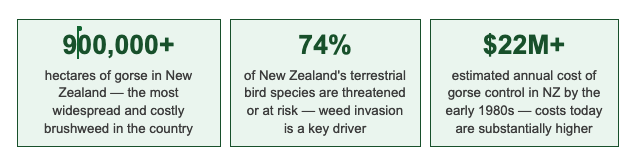
That world no longer exists, and the consequences have been devastating. New Zealand now has the highest proportion of threatened indigenous species of any country on Earth. Of our terrestrial bird species, 74 percent are threatened or at risk. Of our reptiles, 84 percent. Of our freshwater fish, 76 percent. These are not projections — they are the current state of our natural heritage.
Gorse is not the only driver of this crisis, but it is a significant and underappreciated one — particularly for the species that depend on healthy, open, or regenerating hill country habitat.
How gorse destroys habitat
Gorse's impact on native biodiversity is not dramatic and sudden. It is slow, persistent, and cumulative — and that is part of why it is underestimated. As gorse spreads across a hillside, several things happen in sequence:
- Native ground-level plants — including the seedlings of native trees that would otherwise regenerate — are shaded out and excluded by gorse's dense canopy
- Open habitat used by native lizards, ground-nesting birds, and invertebrates disappears, replaced by impenetrable scrub
- The food sources that native birds and insects depend on — native flowers, fruits, and seed — are gradually replaced by gorse, which supports a much narrower range of native wildlife
- As native species disappear from an area, the ecological functions they perform — seed dispersal, pollination, soil aeration — are lost, making natural recovery harder even if gorse is later removed

Native lizards: a Wellington story
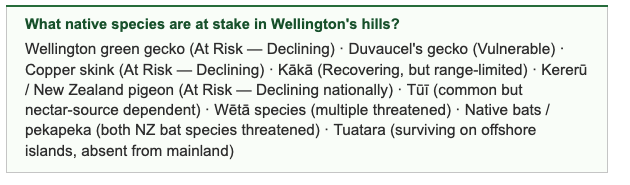
Wellington's hill country is home to a remarkable range of native lizards — including the Wellington green gecko, Duvaucel's gecko, copper skink, and several species of spotted and striped skink. These animals are ancient: gecko ancestors are thought to have colonised New Zealand over 80 million years ago, when it was still part of the supercontinent Gondwana.
Today, all but four of New Zealand's more than 120 native lizard species are threatened or at risk. In the Wellington region specifically, Greater Wellington Regional Council's own conservation assessments have found that over half of the lizard species present on the mainland are regarded as threatened — with introduced predators and habitat loss identified as the chief causes of decline.
Gorse contributes to lizard decline in two ways. First, it eliminates the open, rocky, sun-warmed habitats that many lizard species depend on for thermoregulation and foraging. Second, dense gorse provides excellent cover for introduced predators — rats, stoats, weasels, and feral cats — that move through gorse-covered terrain and prey on lizards with devastating efficiency.
Wellington Zoo's work to rescue lowland speckled skinks and relocate Wellington green geckos to predator-free offshore islands like Matiu/Somes is a direct response to this reality — and a measure of how serious the situation has become for species that were once widespread across the hills visible from the Wellington CBD.
Birds and the ripple effect
Wellington's hills are home to recovering populations of kākā, tūī, kererū, and other native birds — many of them spreading out from ZEALANDIA and other predator-managed sanctuaries. These birds depend on access to native vegetation for food, nesting, and movement through the landscape.
When gorse covers a hillside and native trees cannot establish, it breaks the corridor of native habitat that birds need to move safely across the landscape. A kererū flying between Ōtari-Wilton's Bush and the Polhill Reserve, or between ZEALANDIA and the northern Town Belt, must cross areas where gorse has replaced the native vegetation it depends on. Every hectare of gorse coverage is a break in the ecological network that Wellington's conservation investment is trying to rebuild.
The economic cost
Gorse is officially the most widespread and costly brushweed in New Zealand. It has invaded many thousands of hectares of productive farmland, and its control absorbs millions of dollars annually in herbicide, labour, machinery, aerial spraying, and ongoing follow-up treatment..
A 2022 analysis of the economic cost of biological invasions in New Zealand, drawing on the InvaCost database, found that biological invasions have cost New Zealand an estimated NZ$97 billion over the past 50 years — with damage costs substantially exceeding management expenditure in every decade. Gorse, as the country's most costly plant pest, accounts for a significant share of that damage..
Farm and land productivity
On farmland, gorse directly reduces productivity by occupying land that would otherwise carry pasture. Gorse has invaded many thousands of hectares of New Zealand farmland and on steep or inaccessible country — exactly the kind of terrain found throughout the Wellington region — mechanical clearing is often not economically viable. Land that cannot be economically cleared of gorse may be effectively lost to production indefinitely..
For lifestyle block owners, gorse control costs are a recurring and often significant expense. A single serious infestation on a several-hectare block can cost thousands of dollars to treat — and if the underlying seed bank is not addressed, the cost recurs within a few seasons. Many owners simply give up, and the gorse spreads further..
Property values and amenity
Gorse-covered hillsides visible from residential areas have a measurable effect on the amenity value of neighbourhoods. Properties with views onto gorse scrub, or with gorse encroaching on boundaries, are less attractive to buyers than equivalent properties with native bush or open hillside views. While the precise effect on Wellington property values has not been formally studied, the principle is well-established in property economics: visible environmental degradation reduces amenity and depresses values..
The cost of fire
Wildfire on gorse-covered hillsides is not merely an ecological event — it carries direct economic costs. Fire suppression in Wellington's terrain is resource-intensive, involving helicopters, tankers, and large numbers of fire crew. Evacuation of hillside suburbs carries costs to businesses, emergency services, and affected households. Property damage from fire that escapes control is potentially enormous. And after a fire, gorse typically re-establishes from its seed bank within months — meaning the economic cycle of control begins again..
Prevention — reducing gorse cover before it burns — is substantially cheaper than response. Investing in proactive gorse management on Wellington's hills is, in this sense, an investment in reducing the public cost of emergency response..
The community and wellbeing cost
The impacts of gorse extend beyond ecology and economics into the lived experience of Wellington residents — particularly those who rely on the hills for recreation, mental health, and connection to nature..
The loss of accessible nature
There is a growing body of research establishing that access to natural green space is directly beneficial to mental health, physical wellbeing, and community cohesion. Wellington's hills are one of the city's most significant public health assets — free, accessible, and available to all residents regardless of income..
When gorse encroaches on tracks, closes off viewpoints, and replaces native bush with impenetrable scrub, it erodes this public health asset. The effect is not abstract: walkers who encounter gorse-blocked tracks, dog owners whose dogs are injured by thorns, families who cannot safely explore hillsides they could access a decade ago — these are real losses of wellbeing that affect real people..
Intergenerational and cultural loss
For many Wellington families, the hills are places of memory, identity, and connection to place. Tracks that were walked by grandparents become inaccessible. Views that defined neighbourhoods are obscured. The gradual replacement of native bush with gorse scrub represents a slow erasure of the landscape that people have known and valued — a loss that is felt most acutely by those with the deepest connection to place..
For Māori, the ecological health of Wellington's hill country — ngā puke o Te Whanganui-a-Tara — carries cultural and spiritual significance beyond its recreational value. The degradation of native ecosystems by invasive species is not merely an environmental issue but a diminishment of the living world that tikanga and kaitiakitanga are called to protect..
Volunteer fatigue and the limits of goodwill
Wellington has a remarkable culture of environmental volunteering. Groups like the Ōtari-Wilton's Bush Trust, the Kaiwharawhara Stream Group, and countless community planting groups have contributed hundreds of thousands of volunteer hours to restoration work across the region. Much of that work involves battling gorse — clearing it from track margins, removing it from planting sites, spraying infestations on reserve boundaries..
The scale of the gorse problem means that volunteer effort alone is not sufficient. Where gorse is dense, on steep terrain, and covering large areas, the physical and financial demands exceed what volunteer groups can sustain. This is one of the fundamental arguments for why organised, funded, and technically capable intervention — the kind the Trust is established to deliver — is necessary to complement community effort..
Gorse and climate change: a worsening outlook
The relationship between gorse and climate change runs in both directions — and neither is reassuring..
Climate change favours gorse
Gorse thrives in mild, wet climates. New Zealand climate projections consistently point toward warmer temperatures and altered precipitation patterns across most of the country. In many scenarios, the Wellington region is likely to experience more frequent and prolonged summer droughts, interspersed with more intense rainfall events — conditions that favour gorse's drought-tolerant, fast-establishing characteristics while simultaneously increasing the fire risk from gorse-covered slopes..
Research published in the journal Frontiers in Ecology and the Environment has specifically noted that fire damage in gorse-covered Port Hills terrain is likely to lead to accelerating invasion by fire-adapted weeds including gorse — a feedback loop in which fire clears native vegetation, gorse mass-germinates from the seed bank, and the next fire is worse..
Gorse removal supports carbon sequestration
Replacing gorse with native forest has significant climate benefits. Native podocarp-broadleaf forest sequesters substantially more carbon per hectare than gorse scrub, and does so for far longer time periods. New Zealand's Emissions Trading Scheme provides financial incentives for native afforestation on previously exotic-covered land — creating an alignment between gorse removal, native planting, and carbon accounting that makes restoration investment increasingly economically rational..

Biodiversity loss compounds climate vulnerability
Ecosystems with high native biodiversity are more resilient to climate stress than degraded, weed-dominated systems. A hillside covered in native forest — with its deep root systems, diverse species mix, and intact soil biology — is better placed to withstand the stresses of a changing climate than a hillside dominated by shallow-rooted gorse scrub. Investing in gorse removal and native restoration now builds ecological resilience for the decades to come..
The cumulative case for action
The case against gorse is not made by any single impact in isolation. It is the cumulative weight of multiple serious, interconnected consequences:.
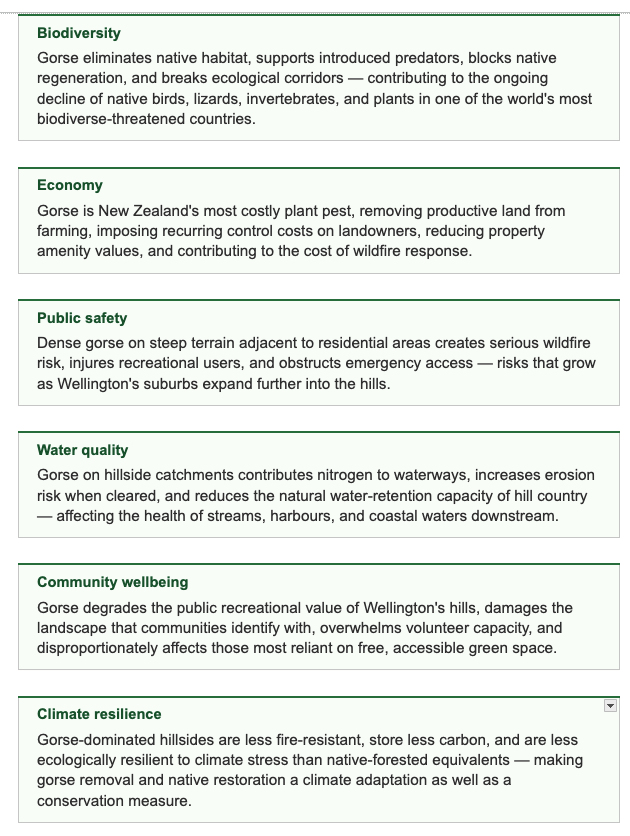
This is why the Wellington Region Hills Environmental Trust exists. Not because gorse is a nuisance. Because it is doing serious damage — to the environment, to the community, to the economy, and to the climate future of the region — and because the terrain where the damage is most severe is precisely the terrain where existing tools and resources fall short.
Explore more